
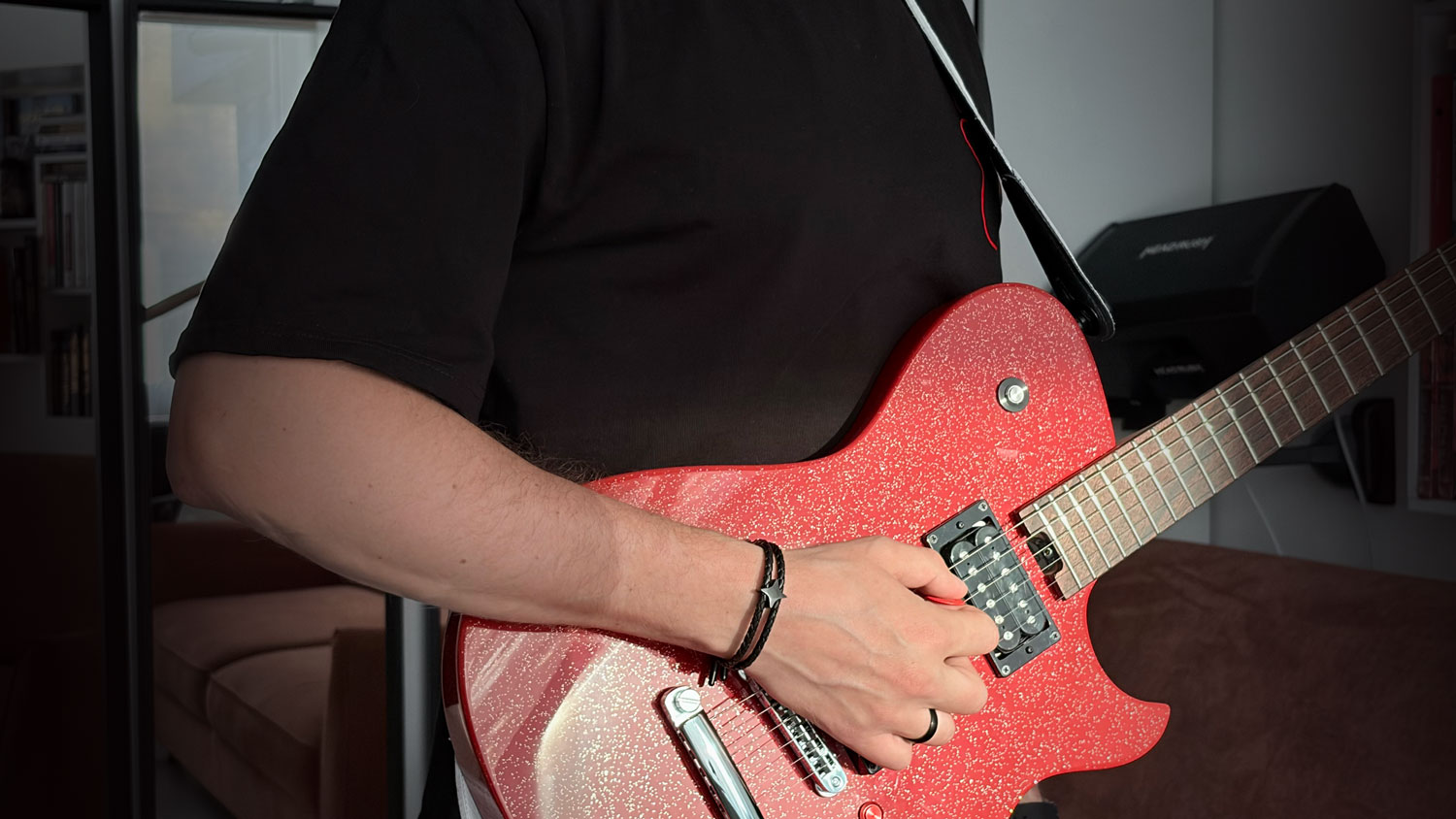
Should your picking motion come from the wrist, the forearm, or the elbow?
This is one of the most common questions guitarists ask when trying to improve speed, accuracy, and endurance.
Some players try to keep the forearm completely still and move only from the wrist. Others rely on a larger motion from the elbow. Some rotate the forearm, while many naturally combine several movements without realizing it.
The goal is not to force every guitarist into one identical technique.
The goal is to understand which part of the arm is creating the picking stroke, whether that movement remains relaxed and controlled, and whether it can be repeated consistently as the tempo increases.
For many alternate-picking situations, a compact wrist-based movement provides an effective balance of speed, accuracy, and control. However, the forearm still has an important supporting role, especially when tracking across the strings, changing dynamics, or playing certain rhythm techniques.
The real question is not simply wrist or forearm.
It is:
Which movement is doing the main work, and is that movement efficient?
Watch the full video explanation:
Quick Answer
For most controlled alternate-picking situations:
- use a small wrist movement as the primary source of the picking stroke;
- keep the shoulder, elbow, and forearm relaxed;
- allow the forearm to support the hand and track naturally across the strings;
- avoid large elbow-driven movements unless they are intentional and comfortable;
- do not try to freeze the entire arm;
- use only as much movement as the phrase requires;
- check that the motion remains consistent as the tempo increases.
A small amount of forearm movement or rotation is not automatically a problem.
The problem begins when the movement becomes larger, tighter, or less controlled than necessary.
Table of Contents
- What Is Wrist Picking?
- What Is Forearm Picking?
- Wrist vs Forearm Picking: The Main Difference
- Why Wrist Picking Often Works Well
- Is Forearm Movement Always Wrong?
- Forearm Rotation vs Elbow Movement
- Is Elbow Picking Bad?
- Rhythm Guitar vs Lead Guitar
- String Crossing and Hand Tracking
- Signs You Are Using Too Much Forearm
- Signs Your Wrist Picking Is Too Tense
- How to Find Your Natural Picking Motion
- Exercises for More Efficient Picking Movement
- How to Change From Forearm Picking to Wrist Picking
- How to Practice With a Metronome
- How to Record and Analyze Your Picking Motion
- 12-Minute Picking Movement Routine
- Frequently Asked Questions
What Is Wrist Picking?
Wrist picking means that the primary motion of the pick is created by movement at the wrist joint.
The hand moves the pick across the string while the forearm remains relatively relaxed and supportive.
The motion does not need to look identical for every player. Depending on the hand position, the wrist may move:
- slightly from side to side;
- along a small diagonal path;
- through a subtle combination of wrist deviation and a small amount of forearm rotation.
The important point is that the movement remains compact, repeatable, and free enough to continue without unnecessary tension.
Wrist picking does not mean that the rest of the arm must be completely motionless.
The forearm may shift slightly as you move across the strings. The elbow may adjust the hand’s position. The shoulder may respond naturally to the instrument’s height and angle.
These supporting adjustments are different from using the entire forearm or elbow to produce every individual pick stroke.
What Is Forearm Picking?
The term forearm picking can describe several different movements.
Large movement from the elbow
The forearm moves up and down because the elbow joint repeatedly opens and closes.
This often creates a larger visible motion and may involve more of the upper arm.
Forearm rotation
The forearm rotates slightly, turning the hand so that the thumb moves toward or away from the guitar.
This can create a compact picking stroke and may be combined with wrist movement.
Forearm tracking
The forearm moves the hand across the strings without producing every individual pick stroke.
For example, the wrist continues creating the downstrokes and upstrokes while the forearm gradually repositions the hand from the low strings toward the high strings.
These three movements should not be treated as the same technique.
Forearm tracking is often a necessary positional adjustment. Forearm rotation can be a useful part of a player’s natural motion. Large elbow-driven picking is a separate approach with different advantages and limitations.
Wrist vs Forearm Picking: The Main Difference
The main difference is the source of the individual picking stroke.
With wrist-based picking, the wrist creates most of the repeated downstroke and upstroke motion.
With elbow-driven picking, the elbow moves the forearm and hand as one larger unit.
With rotational picking, the forearm turns slightly to move the pick through the string.
In real playing, these motions are rarely completely isolated. A guitarist may use wrist movement for the stroke, forearm tracking for string changes, and a small amount of rotation to adjust the pick’s path.
The objective is not to remove every secondary motion.
The objective is to prevent secondary motion from becoming uncontrolled or replacing a more efficient primary movement.
Why Wrist Picking Often Works Well
A compact wrist motion can provide several practical advantages.
Smaller movement
The pick travels only as far as necessary to cross the string and prepare for the next stroke.
This can reduce the time and effort required for each repetition.
Better control of downstrokes and upstrokes
Because the movement is compact, it can be easier to keep both directions balanced.
A weak or unstable upstroke often becomes more obvious when the movement is isolated at the wrist.
Easier adjustment between strings
The wrist can continue producing a similar stroke while the hand tracks gradually across the string set.
Reduced dependence on large arm movement
When the shoulder and elbow are not producing every stroke, they can remain more relaxed.
Better control at moderate and fast tempos
A movement that stays small and consistent is often easier to repeat as the tempo increases.
This does not mean that wrist picking automatically makes someone fast. A tense wrist, deep pick contact, or unstable hand position can still limit the technique.
For more detail on the position supporting the movement, read:
Picking Hand Position: How to Play Faster With Less Tension
Is Forearm Movement Always Wrong?
No.
Trying to eliminate every visible forearm movement can create a new form of tension.
Your forearm supports the picking hand and helps position it over different areas of the strings. It may also rotate slightly as part of your natural picking mechanics.
Forearm movement becomes a problem when:
- it is much larger than the phrase requires;
- it creates tension in the elbow or shoulder;
- the motion becomes less accurate at higher tempos;
- the movement changes dramatically between downstrokes and upstrokes;
- the hand loses its stable relationship with the strings;
- the forearm takes over because the wrist has locked.
A relaxed supporting movement is very different from uncontrolled arm motion.
Do not judge your technique only by whether the forearm appears to move.
Judge it by whether the movement is efficient, consistent, and repeatable.
Forearm Rotation vs Elbow Movement
Forearm rotation and elbow movement are often confused.
Forearm rotation
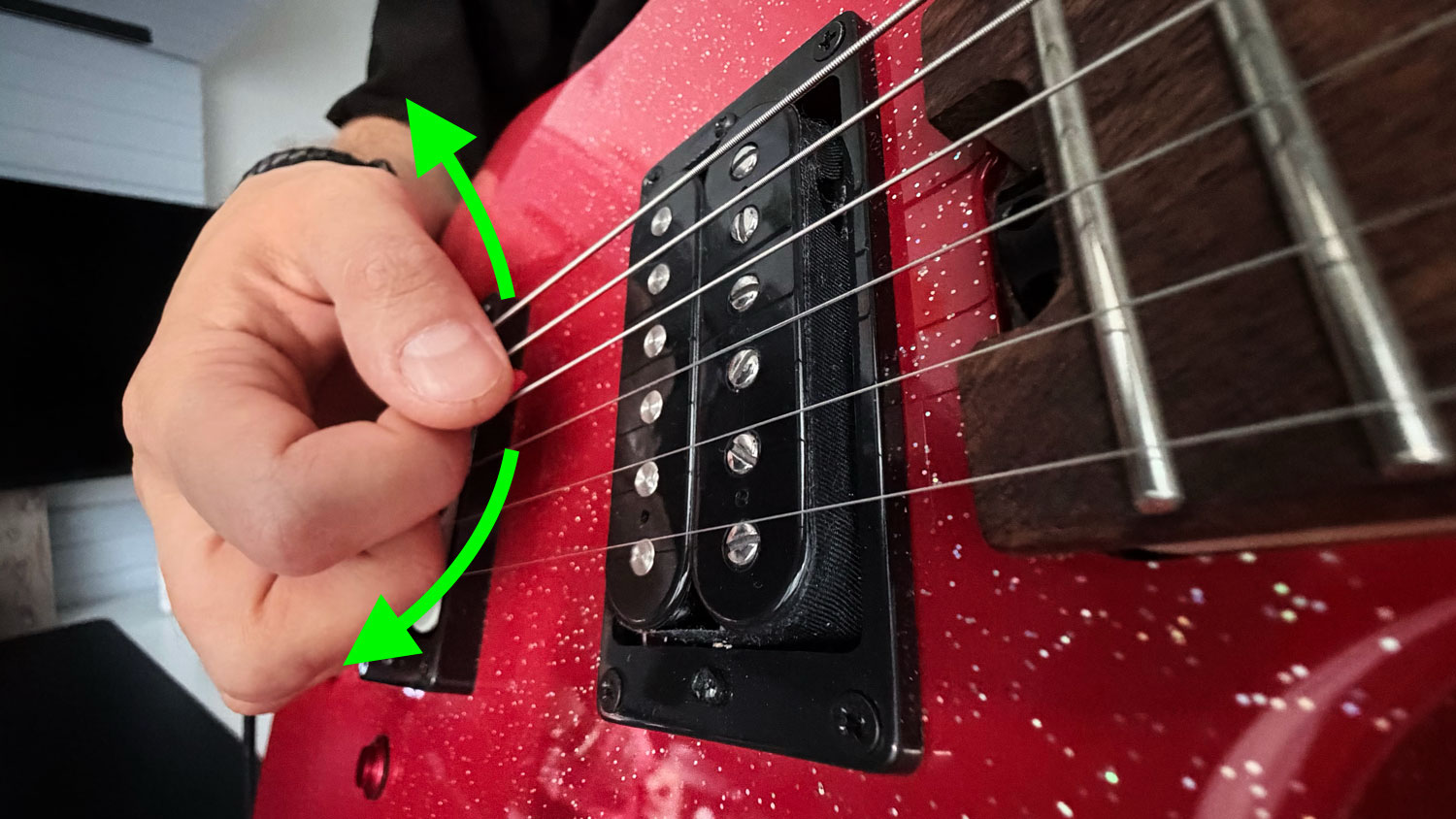
Place your forearm in front of you with the palm facing down. Then rotate it so the palm turns slightly toward the side.
That turning motion is forearm rotation.
A small amount of rotation can contribute to the picking stroke or alter the pick’s path through the string.
Rotation does not automatically mean that the technique is inefficient. For some players, it is part of a comfortable and effective movement.
The problem appears when the rotation becomes excessive or causes the thumb and pick angle to change uncontrollably at speed.
Elbow movement
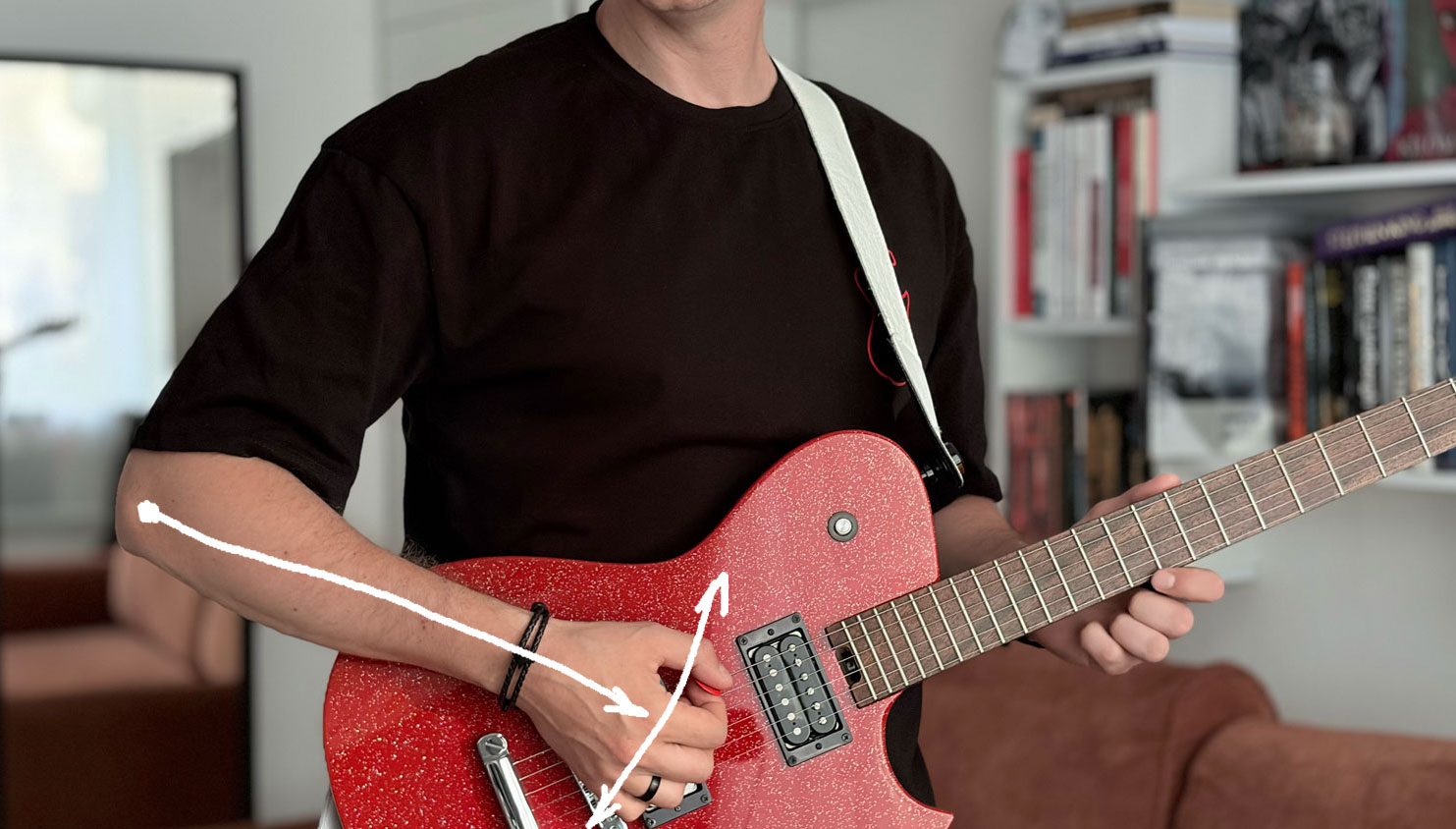
Elbow-driven picking moves the forearm as a larger unit.
The hand may stay relatively fixed while the elbow repeatedly moves the entire forearm.
Because more mass is involved, the motion may feel powerful and natural for certain aggressive passages. However, it can also become larger and more tiring than necessary.
The difference is important:
Forearm rotation turns the hand. Elbow movement moves the whole forearm.
Is Elbow Picking Bad?
Elbow picking is not automatically wrong.
Some guitarists use elbow-driven motion successfully, particularly for:
- fast tremolo picking;
- aggressive rhythm parts;
- short bursts;
- repeated notes on one string;
- passages where power is more important than very small positional adjustments.
However, elbow picking can create problems when a guitarist uses it for everything.
Common limitations include:
- excessive movement;
- difficulty controlling dynamics;
- tension spreading into the shoulder;
- inconsistent string changes;
- loss of precision at moderate tempos;
- reduced endurance;
- difficulty keeping the pick depth shallow.
The biggest warning sign is not simply that the elbow moves.
It is that the movement becomes tighter, larger, or less controlled as the tempo increases.
If elbow picking feels natural, remains painless, and produces consistent results, it does not need to be removed simply because it is visible.
But if your hand becomes unstable, your shoulder tightens, or string changes become inaccurate, reducing the elbow’s role may improve your control.
Rhythm Guitar vs Lead Guitar
Different musical situations may naturally use different combinations of movement.
Rhythm guitar
Heavy rhythm playing often uses more visible forearm movement than precise lead playing.
Downpicked riffs, palm-muted power chords, and aggressive accents may require:
- more force;
- a wider dynamic range;
- stronger contact with the string;
- larger movement across several strings.
However, the motion should still be controlled.
Power should come from a coordinated movement, not from locking the wrist and forcing the entire arm through every note.
For fast alternate-picked rhythm parts, a compact wrist movement often becomes increasingly important because it allows the hand to maintain speed without exhausting the forearm.
Lead guitar
Lead playing often requires:
- smaller movements;
- faster directional changes;
- more precise string selection;
- controlled accents;
- smoother transitions between strings.
For these reasons, wrist-based picking is often especially useful for alternate-picked lead lines.
But even during lead playing, the forearm may still track the hand across the strings or rotate slightly.
The difference is that it supports the motion rather than dominating every stroke.
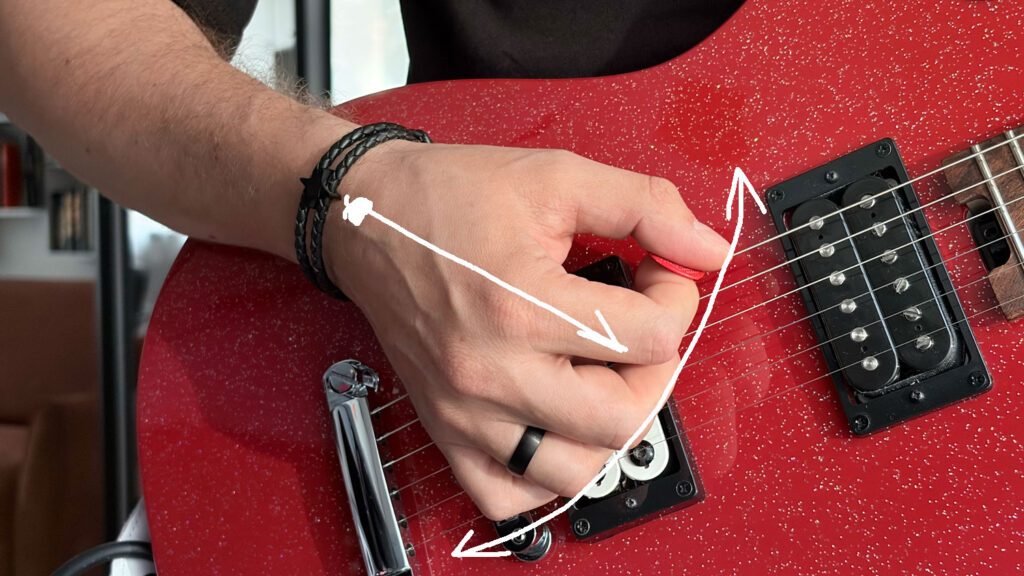
String Crossing and Hand Tracking
One of the most important functions of the forearm is moving the picking hand across the strings.
If you keep the entire arm fixed while moving from the low E string to the high E string, the wrist may be forced into a different angle on every string.
Instead, allow the hand and forearm to track gradually across the guitar.
The picking stroke can remain similar while the entire hand changes position.
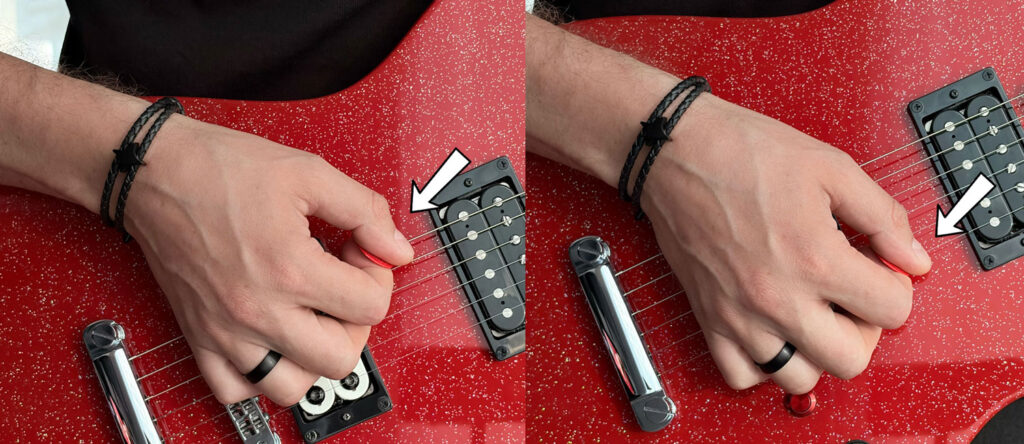
Try playing four alternate strokes on every string:
Low E → A → D → G → B → High E
Then return in the opposite direction.
Watch whether:
- the wrist remains free;
- the hand follows the string set;
- the elbow makes only the positional adjustment required;
- the pick continues moving through a similar path;
- the shoulder remains relaxed.
Do not confuse tracking with using the forearm to create every stroke.
Tracking changes the hand’s location. The wrist can still create the individual picking movement.
Signs You Are Using Too Much Forearm
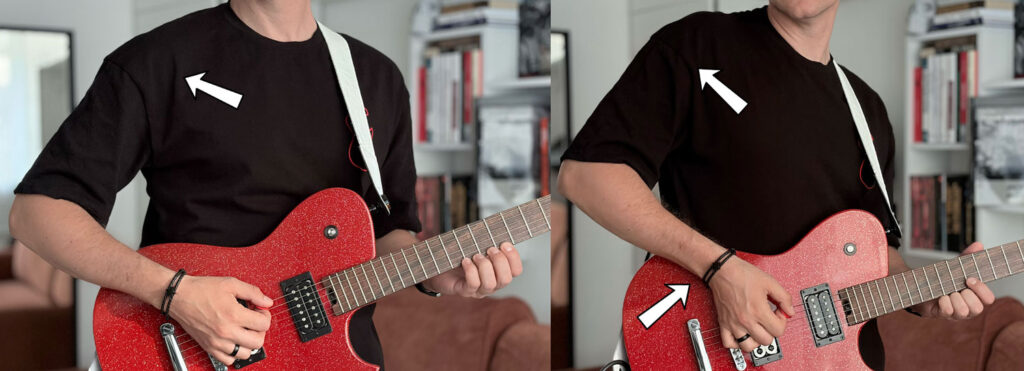
You may be relying too heavily on the forearm or elbow if:
- your elbow moves significantly on every pick stroke;
- your shoulder rises as you increase the tempo;
- the movement becomes visibly larger at speed;
- you cannot play quietly without changing the technique;
- string changes require large jumps;
- the pick enters the string more deeply as the motion grows;
- the wrist becomes rigid;
- the hand loses a stable reference near the bridge;
- you fatigue quickly despite playing a simple repeated pattern;
- your picking feels powerful but difficult to control.
These signs do not prove that all forearm movement is wrong.
They show that your current motion may be using more effort than necessary.
Signs Your Wrist Picking Is Too Tense
Using the wrist does not guarantee relaxation.
Wrist picking may still be inefficient if:
- the wrist feels locked rather than mobile;
- the grip becomes tighter at higher tempos;
- the thumb presses hard against the pick;
- the remaining fingers become rigid;
- the hand pushes strongly into the bridge;
- the movement becomes jerky;
- the upstroke feels weaker than the downstroke;
- the wrist angle becomes increasingly compressed;
- the hand starts shaking after short bursts;
- the technique works only at one narrow tempo.
The solution is not always to use more forearm.
First check whether your hand position, grip pressure, and pick contact are allowing the wrist to move freely.
A separate guide on guitar pick depth will explain how the amount of pick entering the string affects resistance and movement.
How to Find Your Natural Picking Motion
Before trying to rebuild your technique, identify what your hand already does.
Step 1: Play one open string
Use continuous alternate picking at a comfortable tempo.
Do not deliberately change the motion.
Step 2: Observe the joints
Ask:
- Is the wrist moving?
- Is the elbow opening and closing?
- Is the forearm rotating?
- Is the shoulder becoming involved?
- Does the movement change at higher tempos?
Step 3: Change the dynamics
Play quietly, then more aggressively.
A flexible movement should allow dynamic changes without completely changing its structure.
Step 4: Change the tempo
Play the same pattern slowly, moderately, and quickly.
Watch whether the movement becomes larger or tighter.
Step 5: Record from several angles
A movement that feels small can look much larger on video.
Record from:
- the player’s view;
- directly in front of the picking hand;
- the side of the bridge.
Your natural motion is not automatically your ideal motion, but understanding it gives you a better starting point than forcing an unfamiliar technique blindly.
Exercises for More Efficient Picking Movement
The purpose of these exercises is not to make the arm completely motionless.
The goal is to identify the primary motion, reduce unnecessary movement, and maintain consistency.
Exercise 1: Motion Identification
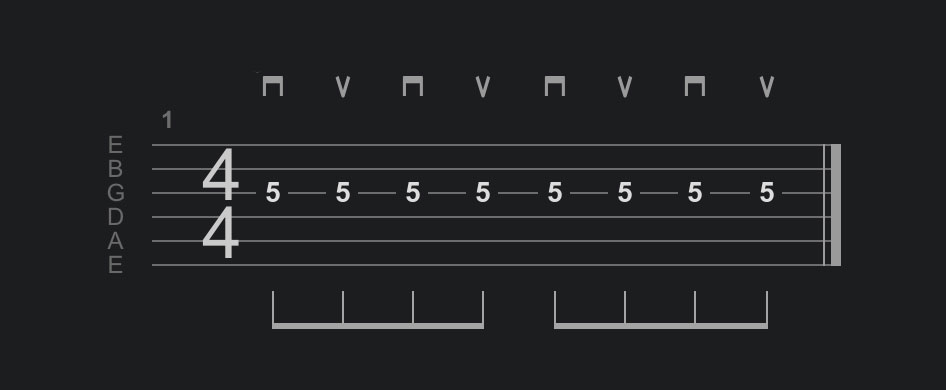
Choose one string.
Play continuous eighth notes at a comfortable tempo for 20 seconds.
Observe which joint is creating the stroke.
Then repeat while deliberately trying:
- mainly wrist movement;
- mainly elbow movement;
- mainly forearm rotation.
The exaggerated comparison will help you feel the difference between the motions.
Do not use this exercise at maximum speed.
Exercise 2: Wrist Isolation
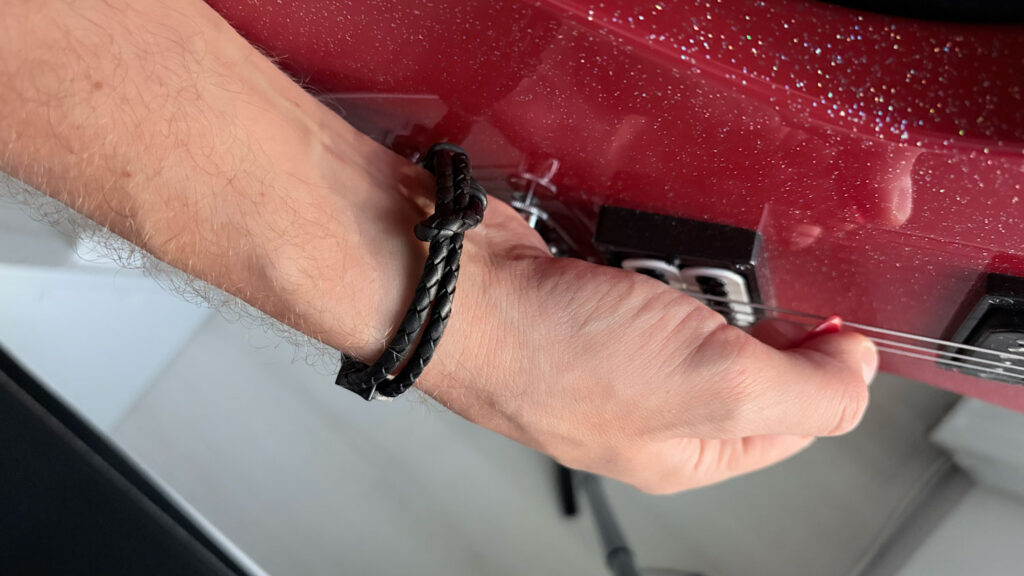
Rest the picking hand lightly near the bridge.
Play a single open string (or the previous pattern) using a small downstroke-upstroke movement.
Keep the shoulder and elbow relaxed.
The elbow does not need to be frozen, but it should not create every stroke.
Continue for 15–20 seconds, then stop and release the hand.
Repeat several short sets rather than one long tense repetition.
Exercise 3: Exaggeration Comparison
Play the same pattern in two deliberately different ways.
First, use an obviously large forearm or elbow movement.
Then reduce the movement until the pick travels only far enough to clear the string.
Compare:
- effort;
- volume;
- accuracy;
- upstroke control;
- shoulder tension;
- endurance.
Exaggerating the inefficient motion temporarily can make the efficient version easier to recognize.
Exercise 4: Movement Reduction
Choose a simple one-string pattern.
Begin at a slow tempo and gradually reduce the visible movement without reducing the clarity of the notes.
Do not try to make the pick stop moving completely.
The movement must still be large enough to cross the string cleanly.
The goal is the smallest reliable stroke, not the smallest imaginable stroke.
Exercise 5: Wrist Movement With String Tracking
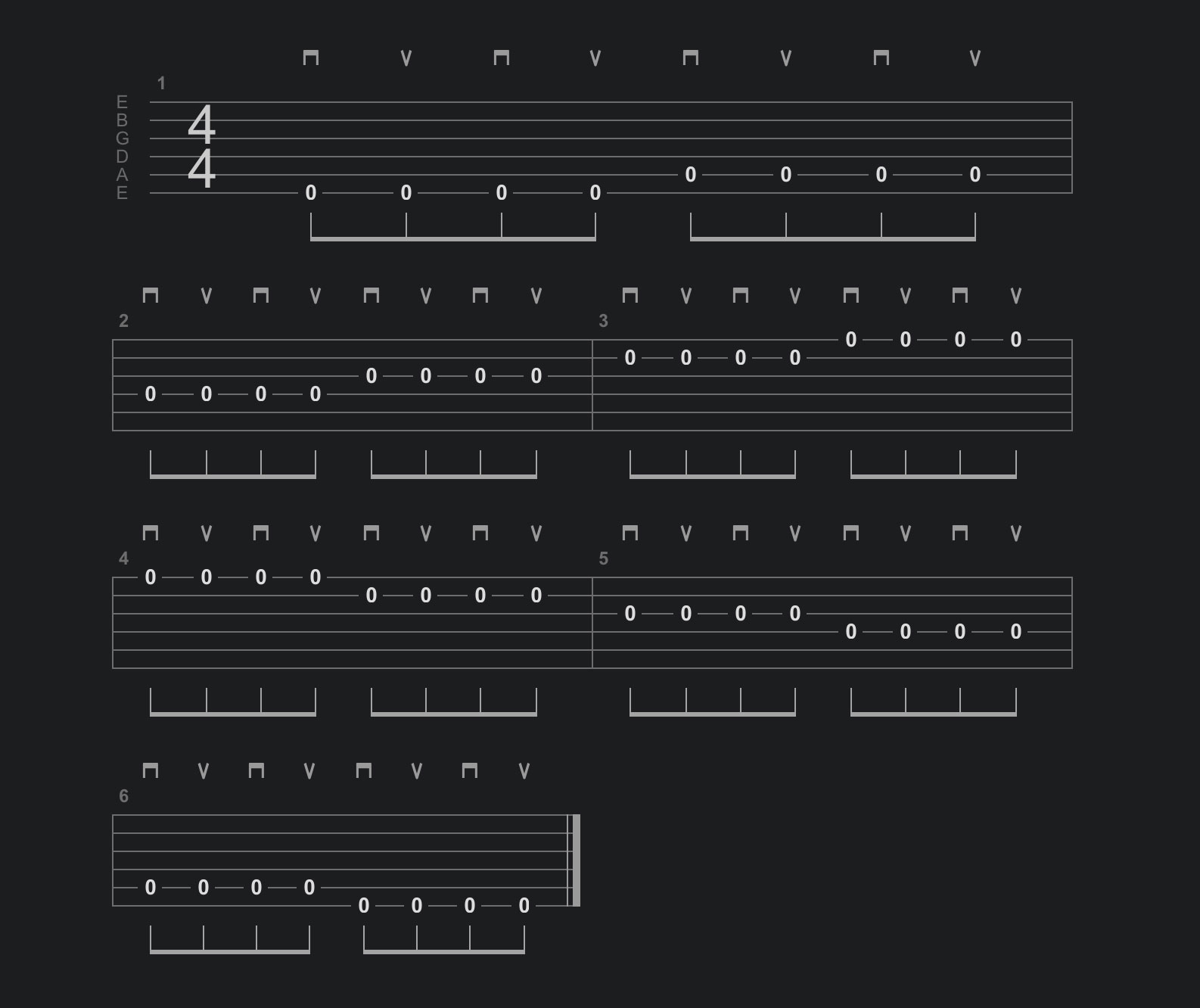
Play four alternate strokes per string across all six strings.
Allow the forearm to reposition the hand while the wrist continues producing the strokes.
Avoid making a separate jump before every string change.
The tracking movement should be gradual and relaxed.
Exercise 6: Short Speed Bursts
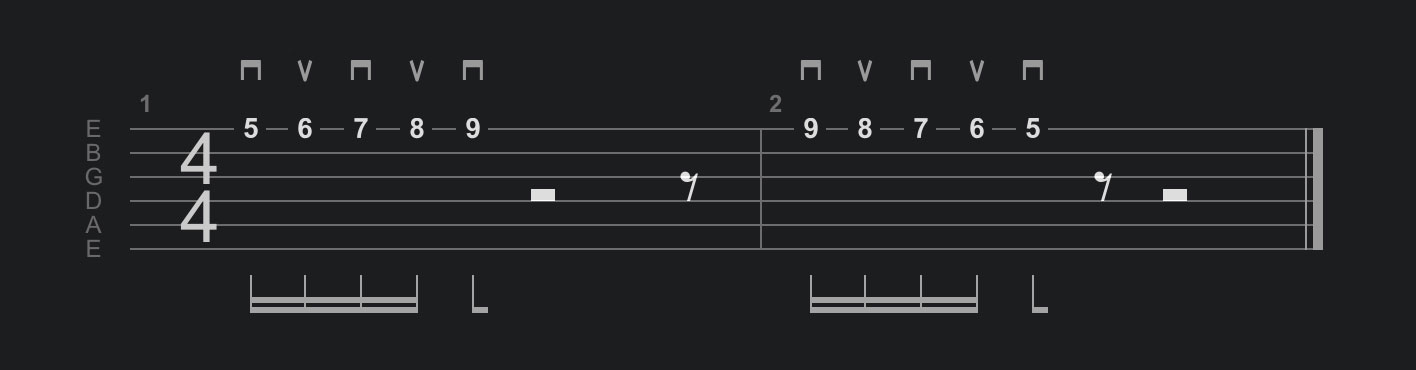
Play five fast notes, then stop.
During the rest:
- release the grip;
- relax the shoulder;
- check the wrist;
- reset the hand position.
Repeat the five-note burst.
Short bursts allow you to experience faster movement without giving tension enough time to accumulate.
If the motion changes during the burst, reduce the tempo.
To turn short bursts into longer, controlled fast playing, you can use my free alternate-picking Guitar Speed Builder workout.
Exercise 7: Forearm Relaxation Reset
Let the arm hang naturally beside the body.
Shake the hand lightly.
Place the forearm back on the guitar without immediately gripping the pick tightly.
Play several slow strokes while maintaining the same relaxed feeling.
Use this reset whenever the forearm or shoulder begins to tighten.
Exercise 8: Accent Without a Larger Motion
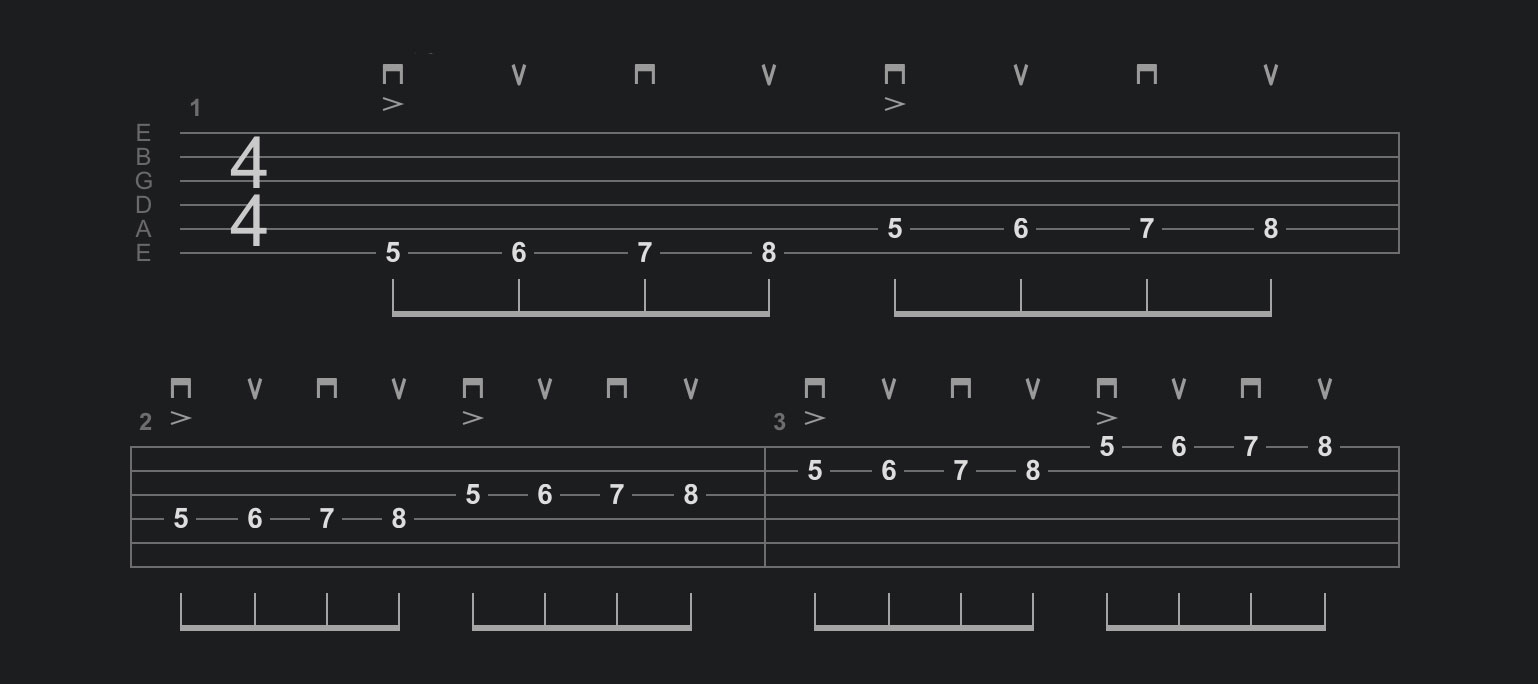
Play continuous alternate picking and accent every fourth note.
Keep the movement size almost the same.
Create the accent through controlled energy and timing rather than a dramatically larger arm motion.
This develops dynamic control without destabilizing the technique.
Exercise 9: Open String to Fretted Pattern
Begin on an open string so you can focus entirely on the picking motion.
Then play a simple fretted pattern, such as:
5–6–7–8
Keep the same picking movement.
If the motion changes as soon as the fretting hand becomes involved, reduce the tempo and simplify the pattern.
A future guide on guitar hand synchronization will explain this interaction in more detail.
Exercise 10: Endurance Test
Choose a comfortable tempo, not your maximum.
Play for 30 seconds while observing:
- shoulder position;
- forearm tension;
- wrist freedom;
- grip pressure;
- movement size;
- timing.
Stop immediately if the movement begins to change.
Rest, reset, and repeat.
The purpose is not to survive through tension. It is to maintain the same efficient technique for the full duration.
How to Change From Forearm Picking to Wrist Picking
Do not try to remove a long-established movement in one practice session.
A sudden complete change often creates stiffness because the player tries to control every joint consciously.
Use a gradual process.
1. Begin with one string
Remove string-crossing and fretting-hand complexity.
2. Use short practice sets
Practice the new motion for 10–20 seconds, then relax.
3. Start below your usual tempo
The new movement needs time to become familiar.
4. Keep the forearm relaxed, not frozen
The goal is to reduce its role in producing each stroke, not to immobilize it.
5. Use small bursts
Test whether the wrist motion remains stable at a slightly faster speed.
6. Add simple fretted patterns
Use patterns that do not require difficult synchronization.
7. Add string changes gradually
Start with two strings before moving across all six.
8. Compare recordings
Check whether the new movement is actually smaller and more stable rather than simply feeling different.
During the transition, your old motion may temporarily feel faster because it is more familiar.
Do not judge the new technique only by maximum BPM.
Judge it by control, effort, consistency, and how easily it can be repeated.
How to Practice With a Metronome
The metronome should help you test the movement, not force you to chase numbers.
Start at a tempo where:
- the wrist remains free;
- the shoulder stays relaxed;
- downstrokes and upstrokes feel balanced;
- the movement size stays consistent;
- the notes remain centered on the click.
Play several clean repetitions.
Increase the tempo in small steps.
If the motion changes before the notes become obviously inaccurate, treat that as the limit.
For example, stop increasing the tempo if:
- the elbow suddenly takes over;
- the shoulder begins to rise;
- the grip tightens;
- the pick travels farther;
- the hand presses harder into the bridge;
- the rhythm begins to rush.
Return to the last tempo where the movement remained stable.
Your clean technical tempo is more useful than the fastest number you can reach once.
For additional alternate-picking practice principles, read:
7 Common Alternate Picking Mistakes and How to Fix Them
How to Record and Analyze Your Picking Motion
Record the same pattern from three angles.
Player’s view
Shows:
- movement size;
- pick path;
- string tracking;
- thumb movement;
- hand position.
Front view
Shows:
- elbow involvement;
- shoulder tension;
- forearm motion;
- vertical movement of the hand.
Side view
Shows:
- pick contact;
- wrist angle;
- bridge pressure;
- movement through the string.
Record three tempos:
- comfortable;
- challenging but controlled;
- near your current limit.
Then compare them.
Ask:
- Does the movement become larger?
- Does the wrist lock?
- Does the elbow take over?
- Does the shoulder rise?
- Does the forearm rotate more?
- Does the pick grip change?
- Does the hand move away from its normal position?
Often the visible movement begins to change before the playing sounds obviously inaccurate.
That early change is valuable information.
12-Minute Picking Movement Routine
Minutes 1–2: Relaxation and Position Reset
- release the shoulder;
- check the forearm contact;
- hold the pick with minimum necessary pressure;
- play slow open-string strokes.
Minutes 3–4: Wrist Isolation
- use one string;
- keep the movement compact;
- pause frequently;
- reset at the first sign of tension.
Minutes 5–6: String Tracking
- play four strokes per string;
- move across all six strings;
- allow the forearm to reposition the hand;
- keep the picking stroke consistent.
Minutes 7–8: Short Speed Bursts
- play four fast notes;
- stop completely;
- release tension;
- repeat.
Minutes 9–10: Simple Fretted Pattern
- use a 5–6–7–8 chromatic pattern;
- maintain the same picking movement;
- listen for balanced downstrokes and upstrokes.
Minutes 11–12: Controlled Tempo Test
- choose a manageable metronome tempo;
- play continuously for 20–30 seconds;
- stop if the movement changes;
- finish with a relaxed repetition.
This routine is more effective when practiced consistently than when used as an occasional maximum-speed test.
Related Guitar Technique Guides
Picking Hand Position: How to Play Faster With Less Tension
Learn how bridge contact, wrist position, grip pressure, guitar height, and string tracking affect the movement of your picking hand.
7 Common Alternate Picking Mistakes and How to Fix Them
Identify tension, excessive pick depth, weak upstrokes, oversized movement, string-crossing problems, and unstable tempo progression.
How Deep Should the Pick Go Between the Strings?
A detailed guide to pick depth, string resistance, pick exposure, and why the pick may feel trapped between the strings.
Why Your Hands Lose Synchronization at Higher Speeds
A practical guide to timing problems between the picking and fretting hands, speed bursts, and identifying which hand is failing.
Frequently Asked Questions
Should I pick only from the wrist?
Not necessarily.
For many alternate-picking situations, the wrist can create the primary stroke while the forearm and elbow make smaller supporting adjustments.
Trying to freeze the entire arm may create unnecessary tension.
Is forearm picking wrong?
No.
Forearm rotation, string tracking, and small positional adjustments can all be useful.
The problem is excessive or uncontrolled movement that reduces accuracy, increases tension, or changes at higher tempos.
Is elbow picking always bad?
No.
Some players use elbow movement successfully for tremolo picking, aggressive rhythm playing, or short high-speed passages.
It becomes a limitation when the motion is too large, tense, inaccurate, or difficult to sustain.
Can forearm picking be faster than wrist picking?
It can feel faster in certain situations, particularly during repeated notes or aggressive tremolo picking.
However, maximum speed is only one factor.
The movement must also provide accuracy, endurance, dynamic control, and reliable string changes.
Should my forearm stay completely still?
No.
The forearm may track the hand across the strings or rotate slightly.
It should remain relaxed and avoid producing more movement than necessary.
How do I know whether I am picking from the wrist?
Record your hand from the front and from the player’s view.
If the hand moves primarily at the wrist while the elbow remains relatively stable, the technique is mainly wrist-based.
Why does my elbow start moving when I play faster?
The wrist may be tightening, the movement may be too large, or the body may be recruiting a stronger joint to maintain the tempo.
Reduce the speed and check whether the wrist can continue the motion without the elbow taking over.
Should I eliminate all forearm rotation?
No.
A small amount of rotation may be part of your natural and efficient picking movement.
Only reduce it if it becomes excessive, unstable, or creates tension.
Is wrist picking better for string crossing?
A compact wrist movement can make string changes easier to control, but the forearm still needs to track the hand across the strings.
Efficient string crossing usually involves coordination between the picking stroke and the hand’s position.
Can I use different movements for different techniques?
Yes.
You may use one movement for alternate-picked lead lines, another for aggressive downpicking, and a slightly different combination for tremolo picking or palm-muted rhythm.
The important point is that each movement remains controlled and repeatable.
How long does it take to change picking movement?
It depends on how established the old technique is and how consistently you practice the new movement.
Expect the new motion to feel unfamiliar at first. Focus on short, accurate repetitions rather than immediately trying to recover your previous maximum speed.
Should I stop if my wrist or elbow hurts?
Yes.
Normal technical practice should not produce sharp pain, numbness, burning, or persistent discomfort.
Stop, rest, and review the position and movement. Seek qualified medical advice if symptoms continue.
Final Thoughts
The best picking movement is not the one that looks perfectly motionless or follows a rigid rule.
It is the movement that allows you to play with control, consistency, and minimum unnecessary effort.
For many guitarists, that means using the wrist as the primary source of alternate-picking motion while allowing the forearm to remain relaxed and make natural supporting adjustments.
Watch what happens as you approach your speed limit.
If the shoulder rises, the wrist locks, the grip tightens, or the elbow suddenly takes over, the movement is beginning to change before the technique is ready.
Do not force the faster version.
Return to the last tempo where the motion remained stable, then build from there.
Use the wrist for control. Let the forearm support the position. Keep every movement as large as necessary — and no larger.
Personal Guitar Technique Analysis
If you are unsure whether your picking movement comes from the wrist, forearm, or elbow—or your technique changes whenever you increase the tempo—I can analyze your playing in detail.
Send a clear video showing both hands, and I will identify:
- where your picking motion comes from;
- where unnecessary tension appears;
- whether the movement becomes too large;
- how your hand position affects the technique;
- what happens during string changes;
- which exercises should be prioritized.
You will receive a private video breakdown, a structured PDF, and practical exercises based on your playing.
Support My Work
Not looking for personal feedback? If my guitar lessons, articles, and free resources have helped you, you can support my work and help me create more free guitar content.