
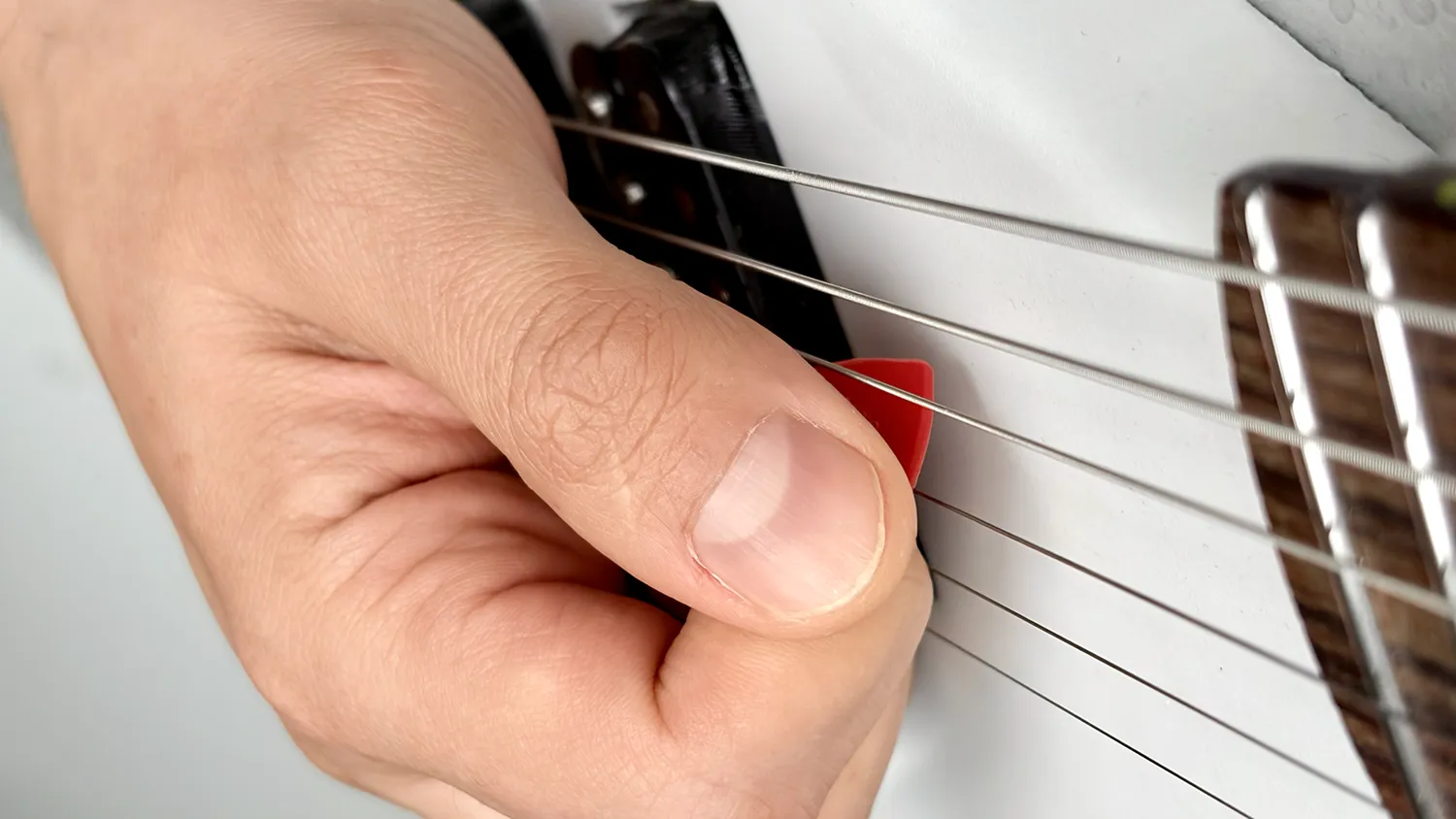
You may be able to alternate pick cleanly on one string, but everything changes as soon as you have to move to the next one.
The pick starts catching the strings. Your movement becomes larger. Your timing becomes less consistent. Or one type of string change feels comfortable while the other immediately causes problems.
This is extremely common.
One reason is simple: not every string change creates the same movement for the picking hand.
A transition after a downstroke and a transition after an upstroke place the pick in different positions relative to the strings. If one of those movements is weaker or less controlled, it may become the first thing that breaks down when you increase the tempo.
In this guide, we will isolate both transitions, practice them separately, and then put them back together into normal alternate picking.
Watch the Exercise
While practicing, watch what happens immediately before the string change.
If the movement suddenly becomes larger, the wrist locks, or the entire arm jumps to the next string, reduce the tempo and reset.
Quick Answer
Alternate picking becomes more difficult when you cross strings because the picking hand has to do two things at once:
continue the down-up picking cycle while moving cleanly to another string.
With an even number of notes per string — such as two or six — the same type of string transition can repeat from string to string.
With an odd number — such as one or three — the transition alternates.
That is why it is useful to practice string changes after a downstroke and after an upstroke separately.
Once both movements are controlled, combine them again in normal alternate picking.
Table of Contents
- Why String Changes Make Alternate Picking Harder
- String Changes After an Upstroke vs After a Downstroke
- Why Pentatonic Patterns Often Feel More Predictable
- Even vs Odd Notes Per String
- Three Notes Per String: Why the Transition Keeps Changing
- Exercise 1: String Changes Beginning With a Downstroke
- Exercise 2: String Changes Beginning With an Upstroke
- Why Practice the Two Movements Separately?
- How to Combine Them Again
- Common String-Crossing Mistakes
- Picking-Hand Movement During String Changes
- How to Practice With a Metronome
- Short String-Crossing Practice Routine
- FAQ
- Final Thoughts
Why String Changes Make Alternate Picking Harder
Picking repeatedly on one string is mechanically simple.
The string stays in the same place, so the picking hand can repeat essentially the same movement:
D U D U D U
When you move to another string, however, the pick must change its position while preserving the same rhythm and alternate-picking cycle.
This introduces several possible problems.
The movement may become larger. The pick may travel too deeply between the strings. The hand may suddenly change its angle. The wrist may become less free. The forearm or elbow may begin compensating for a string change that the player does not yet control.
Sometimes the fretting hand is perfectly capable of playing the notes, but the picking hand cannot reach the next string cleanly enough.
This is why a guitarist can feel fast on one string but significantly slower when playing scales or licks across several strings.
If your basic picking position changes whenever you cross strings, read my guide on Picking Hand Position.
String Changes After an Upstroke vs After a Downstroke
A string change after an upstroke is a U → D transition.
A string change after a downstroke is a D → U transition.
The two transitions are not identical.
Imagine you are using strict alternate picking.
After a downstroke, the next note must be played with an upstroke.
After an upstroke, the next note must be played with a downstroke.
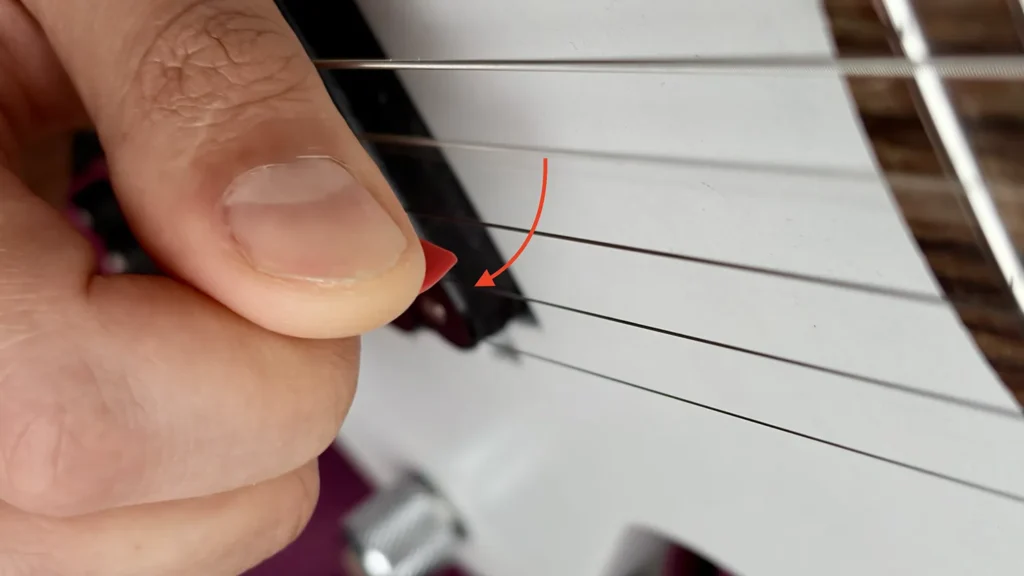
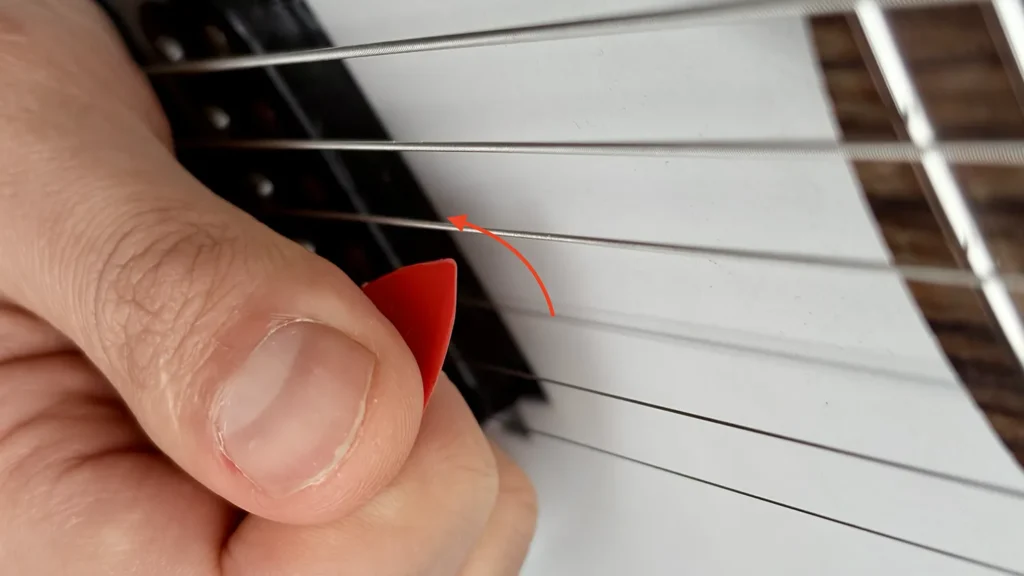
On one string this is obvious. But when the next stroke is also on a different string, the pick has to reposition at the same time.
For many players, one transition feels natural while the other requires a slightly different path that is less developed.
Depending on your picking motion, one stroke may naturally escape the strings more easily than the other. The goal is not to force both transitions to look identical, but to understand what your hand needs to do to cross the strings cleanly.
That imbalance may be almost impossible to notice at slow tempos.
At higher speeds, however, it becomes obvious.
One transition remains clean.
The other catches the string, becomes too large, changes the wrist motion, or throws the two hands out of synchronization.
This is exactly why isolating the two movements can be so useful.
Why Pentatonic Patterns Often Feel More Predictable
There is an interesting reason why many two-note-per-string pentatonic patterns can feel mechanically predictable during alternate picking.
Consider a pattern with two notes on every string, beginning with a downstroke:
D U | D U | D U | D U
Every string contains an even number of notes.
That means you finish every string with the same stroke — in this example, an upstroke — and begin the next string with a downstroke.
So the type of transition repeats:
U → D
U → D
U → D
The picking hand can repeat the same basic string-change sequence.
This does not mean that pentatonic alternate picking is automatically easy for every guitarist. Different picking motions can make particular string crossings feel easier or harder.
But the stroke sequence itself remains predictable.
That is an important difference from patterns containing an odd number of notes per string.
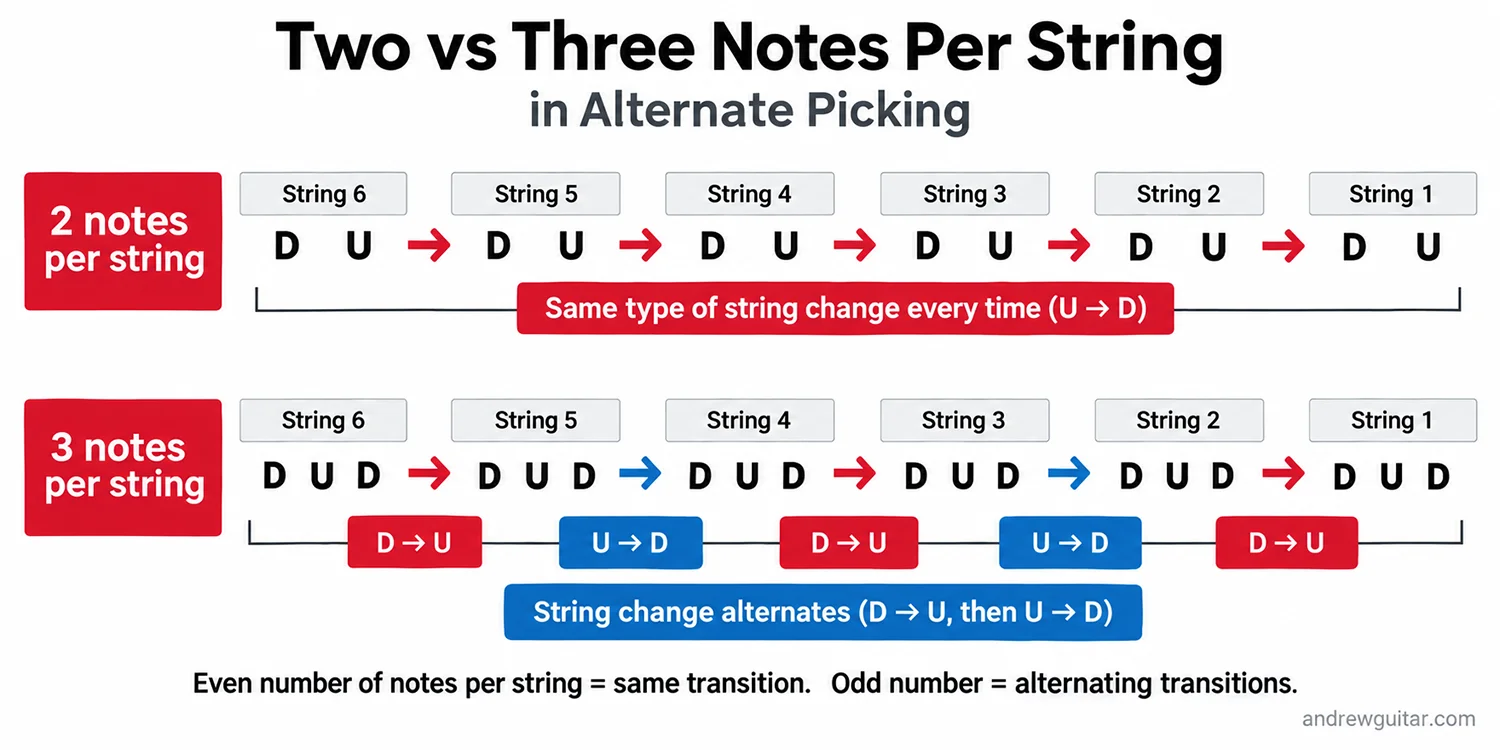
These examples move across adjacent strings in one direction. If you reverse direction, the same U → D or D → U stroke sequence can create a different inside/outside string-crossing relationship.
Even vs Odd Notes Per String
The easiest way to understand this is to look at whether the number of notes on each string is even or odd.
| Notes per string | Example picking pattern | String-change behavior |
|---|---|---|
| 1 | D | U | D | U | Transition alternates |
| 2 | D U | D U | D U | Same type repeats |
| 3 | D U D | U D U | D U D | Transition alternates |
| 6 | D U D U D U | D U D U D U | Same type repeats |
With strict alternate picking, an even number of notes per string returns the picking cycle to the same starting stroke on each new string.
An odd number reverses it.
This is also why a six-note-per-string sequence can preserve the same basic string-change relationship even though it contains far more notes than a pentatonic shape.
The important factor is not whether you play two or six notes.
It is whether the number is even or odd.
Three Notes Per String: Why the Transition Keeps Changing
Now look at a three-note-per-string scale:
D U D | U D U | D U D | U D U
The first string ends with a downstroke.
The next string therefore begins with an upstroke.
But that string ends with an upstroke, so the following string begins with a downstroke.
The string-change pattern alternates continuously:
D → U
then
U → D
then
D → U
and so on.
Your picking hand cannot simply repeat one identical transition across the entire scale.
It has to handle both versions.
This is one reason three-note-per-string diatonic scales can expose string-crossing weaknesses that may remain hidden when you play two-note-per-string pentatonic shapes.
The same principle becomes especially obvious with one note per string, where every new string immediately requires the opposite picking stroke.
The challenge is not necessarily the scale itself.
The challenge is that the picking hand must remain stable while the type of transition keeps changing.
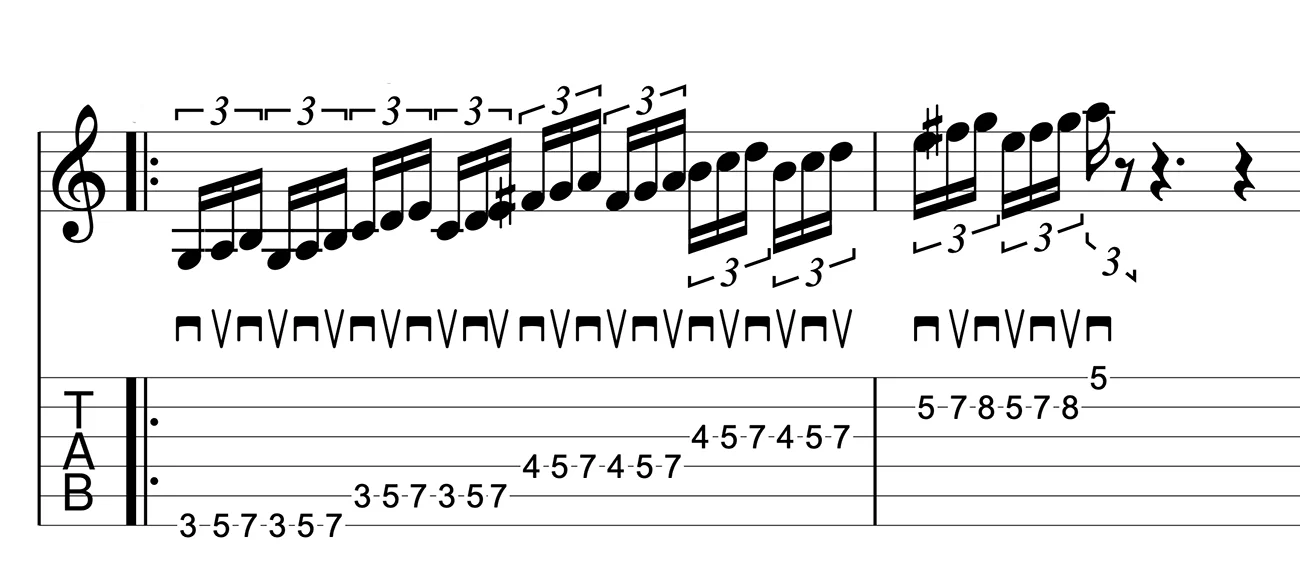
Exercise 1: String Changes Beginning With a Downstroke
This exercise isolates U → D string changes: you finish the previous string with an upstroke and begin the new string with a downstroke.
Instead of trying to solve every possible picking movement at once, you repeat one transition until the hand understands the path.
Start slowly.
Pay attention to three things:
- Keep the pick movement small.
- Do not push the pick unnecessarily deep between the strings.
- Keep the wrist and forearm relaxed while moving to the next string.
The goal is not speed yet.
The goal is to make every repetition feel predictable.
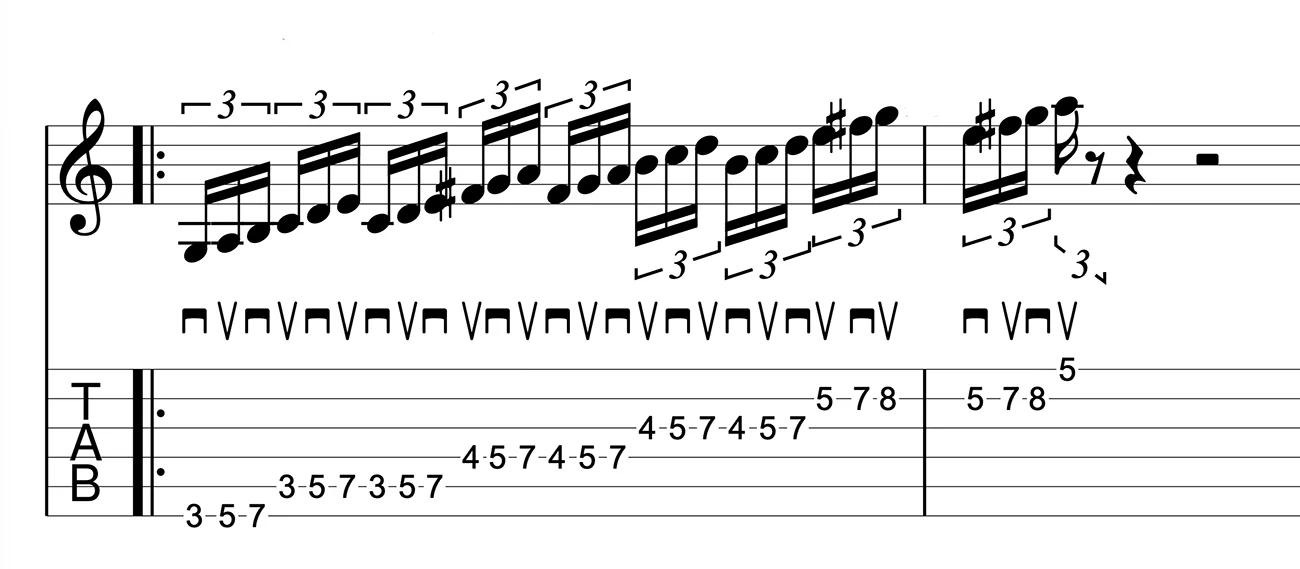
Exercise 2: String Changes Beginning With an Upstroke
This exercise isolates D → U string changes: you finish the previous string with a downstroke and begin the new string with an upstroke.
Now isolate the opposite transition.
This may feel surprisingly different even though the notes themselves are similar.
For some guitarists, this version feels easier.
For others, this is exactly where the pick begins to catch between the strings.
That difference is useful information.
It tells you that your speed limitation may not come from your general ability to move the pick quickly. It may come from one specific string transition.
Again, keep the movement small and controlled.
Do not try to force the difficult transition to match the speed of the easier one immediately.
Build the weaker movement first.
Why Practice the Two Movements Separately?
This is an exercise, not a rule for how you must play music.
You are deliberately reducing a complicated movement into smaller pieces.
When both transitions appear inside a three-note-per-string scale, your picking hand has to alternate between them continuously.
If one is weak, it can be difficult to understand exactly what caused the mistake.
Isolating the transition removes that uncertainty.
You can focus on:
pick path → string contact → wrist movement → timing → next string
without simultaneously reacting to several different string crossings.
Once the motion becomes reliable, you put the pieces back together.
This is the same principle I use frequently when analyzing a player’s technique: find the specific movement that fails first instead of repeatedly practicing the entire passage that contains the problem.
How to Combine Them Again
Once both exercises feel controlled individually, return to normal alternate picking.
A three-note-per-string scale is perfect for this because it forces both transitions to appear.
Do not think:
“Now I have to perform Exercise 1, then Exercise 2.”
Instead, allow the picking motion to become continuous again.
The isolated exercises were there to teach your hand both paths.
Now the objective is to move freely between them without changing your rhythm or increasing tension.
Start well below your maximum speed.
Play through several strings.
If the same transition fails repeatedly, return briefly to the isolated exercise, correct it, and then test the full pattern again.
That loop is much more productive than simply playing the complete scale faster and hoping the problem disappears.
Common String-Crossing Mistakes
1. Using Too Much Pick Depth
If too much of the pick goes below the surface of the string, every transition requires more movement to escape and reach the next string.
Keep the contact shallow enough that the pick can move through the string without feeling trapped.
2. Increasing the Movement During the String Change
A common pattern is:
small movement on one string → large jump during the crossing → small movement again.
Try to make the transition part of the same controlled picking motion instead of treating it as a separate jump.
3. Changing the Entire Picking-Hand Position
Your hand naturally needs to track across the strings.
But tracking does not mean rebuilding your picking position every time you move to another string.
For a deeper explanation, see Wrist vs Forearm Picking: Which Movement Should You Use?.
4. Uncontrolled Elbow or Shoulder Compensation at Speed
Elbow movement itself is not automatically a problem. But if a difficult string crossing suddenly causes a much larger elbow movement, rising shoulder, extra tension, or loss of timing, the motion may be compensating for an inefficient transition.
5. Practicing Only the Easier Transition
If one exercise immediately feels better, it is tempting to spend most of your time playing it.
Do the opposite.
Use the easier one as a reference for relaxation and control, then gradually teach the weaker transition to feel equally stable.
6. Continuing After the First Mistake
When the movement becomes less controlled or noticeably less efficient, stop.
Do not play another ten bad repetitions.
Reset the hand and repeat the transition correctly.
For more common alternate-picking problems, see my guide to 7 Common Alternate Picking Mistakes and How to Fix Them.
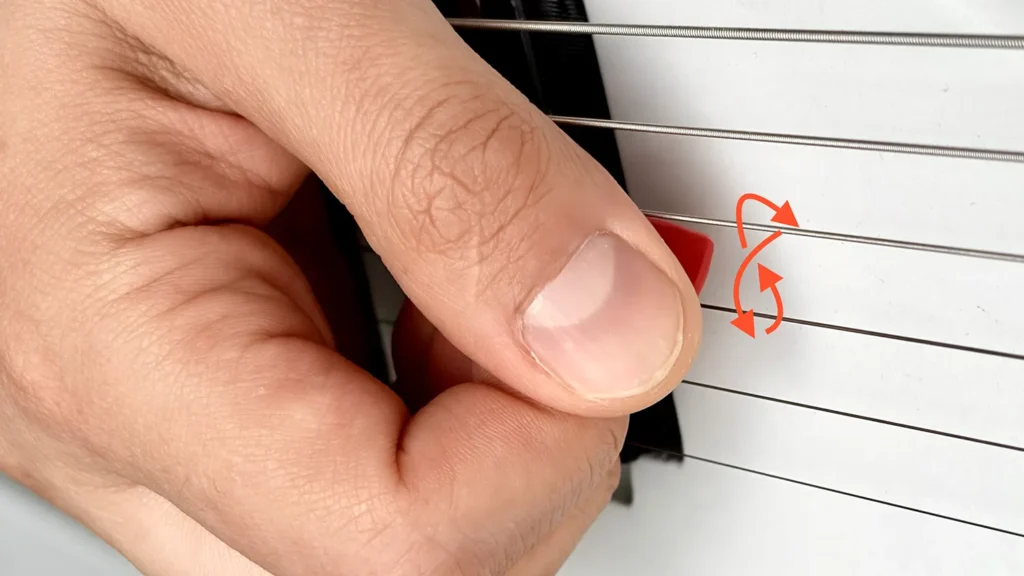
Picking-Hand Movement During String Changes
Your picking hand does not need to be frozen in one position.
The wrist can create the primary picking movement while the forearm helps support and reposition the hand as you move across the strings.
What matters is that the supporting movement does not become unnecessarily large.
Watch your hand from the front.
At slow speed, then slightly faster.
Ask yourself:
Does my wrist motion remain similar?
Does the pick stay close to the strings?
Does my shoulder remain relaxed?
Does one particular string change make my elbow suddenly move more?
Recording yourself is extremely useful here because subtle changes in the movement can appear before you hear obvious mistakes.
How to Practice With a Metronome
Do not begin by asking:
How fast can I play this?
First find a tempo where the transition is completely controlled.
Play several clean repetitions.
Then increase the tempo gradually.
If the movement becomes less controlled or efficient before the notes actually become wrong, treat that as your current limit.
That could mean:
- the pick travels deeper;
- the motion becomes wider;
- your grip becomes tighter;
- the wrist locks;
- the elbow movement becomes unnecessarily large;
- the timing becomes less even.
Reduce the tempo slightly and rebuild the movement.
Once your string changes remain stable and you want to develop the speed further, use my free Guitar Speed Builder workout.
The purpose is not to survive one fast repetition.
The purpose is to make the same movement repeatable at progressively higher tempos.
Short String-Crossing Practice Routine
You do not need a long workout.
2 minutes — Exercise 1
Practice the first transition slowly and accurately.
2 minutes — Exercise 2
Practice the opposite transition.
Pay particular attention to whichever one feels less natural.
2 minutes — Alternate Between Them
Play a few repetitions of Exercise 1, then Exercise 2.
Try to keep the basic picking-hand position stable as you move across the strings.
2 minutes — Apply It
Use a three-note-per-string scale or another pattern that forces the two transitions to alternate.
Stop if one transition becomes noticeably less controlled or less efficient.
2 minutes — Controlled Speed
Increase the tempo slightly or use short bursts.
The movement should remain controlled and efficient as the tempo increases. Avoid sudden increases in tension, pick depth, or unnecessary motion.
Total: approximately 10 minutes.
That is enough if the repetitions are focused.
FAQ
Why are string changes harder than picking on one string?
Because the picking hand must continue the alternate-picking cycle while simultaneously moving the pick to another string. This adds another coordination requirement that does not exist during repeated single-string picking.
Why do three-note-per-string scales feel harder to alternate pick?
With three notes per string, the number of notes is odd. Under strict alternate picking, the stroke used at each new string therefore alternates. One string may require one type of transition and the next requires the opposite one.
Why can pentatonic scales feel more predictable?
Common pentatonic fingerings use two notes per string. Because two is an even number, the same picking sequence can repeat on every string — for example, D U | D U | D U.
This can make the string-change pattern more predictable, although it does not mean two-note-per-string picking is universally easier for every player.
Is six notes per string similar to two notes per string?
In terms of the alternate-picking cycle, yes. Both contain an even number of notes, so the same starting stroke can repeat on each new string.
Six notes per string obviously creates different fretting and rhythmic demands, but the even/odd principle remains the same.
What happens with one note per string?
One note is an odd grouping, so the picking stroke changes every time you move to the next string:
D | U | D | U
This can make one-note-per-string alternate picking particularly useful for exposing weak string transitions.
Should I practice string changes starting with both downstrokes and upstrokes?
Yes.
If you always start patterns with the same stroke, you can accidentally become very comfortable with one transition while avoiding the other.
Being able to begin with either stroke gives you more flexibility and makes weaknesses easier to identify.
Is inside picking or outside picking better?
Neither is automatically better.
Different phrases create different string-crossing situations, so a complete alternate-picking technique should allow you to handle both without excessive tension or unnecessary movement.
How fast should I practice these exercises?
Start at a tempo where every transition is clean and your movement remains relaxed.
Increase the tempo only while the motion stays consistent. Your technical limit begins when the movement becomes less efficient — for example, when tension, pick depth, unnecessary motion, or timing errors start to increase.
Final Thoughts
Alternate picking problems are often more specific than they first appear.
You may not have a general “speed problem.”
You may simply have one string transition that is less developed than the other.
That is why playing the same scale faster and faster does not always solve the issue.
Separate the movements.
Practice the transition after the downstroke.
Practice the transition after the upstroke.
Then combine them again.
Even-note-per-string patterns can help you repeat one type of transition, while odd-note-per-string patterns force the two types to alternate.
Understanding that difference makes it much easier to diagnose what your picking hand is actually doing.
Build both transitions first. Then build the speed.
Personal Guitar Technique Analysis
If your alternate picking works on one string but starts breaking down during string changes, the exact cause can be difficult to see while you are playing.
Send me a video of your technique and I’ll analyze your picking motion, string transitions, tension, synchronization, and the first thing that begins to change as you increase the speed.
You will receive a private video breakdown, a structured PDF, and practical exercises based on your playing.
Support My Work
Not looking for personal feedback? If my guitar lessons, articles, and free resources have helped you, you can support my work and help me create more free guitar content.